
MCD Demolition and Sealing Notices: The First Steps and the Appeal
The Municipal Corporation of Delhi acts against unauthorised construction and misuse under the Delhi Municipal Corporation Act, 1957.
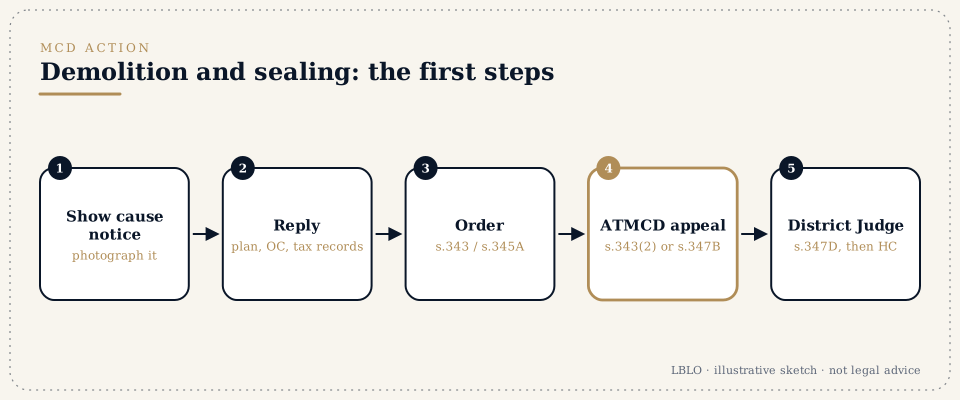
In brief
- The Municipal Corporation of Delhi acts against unauthorised construction and misuse under the Delhi Municipal Corporation Act, 1957 (DMC Act). The usual actions are:
- a show cause notice;
- a demolition order (Section 343);
- a sealing order (Section 345A);
- action on dangerous buildings or vacation of premises (Sections 348 and 349).
- Appeal. Demolition and sealing orders can be appealed to the Appellate Tribunal, MCD (ATMCD). A demolition order is appealed under Section 343(2) within the period specified in the order, which is between five and fifteen days from its delivery, and the section makes no provision for condoning delay. A sealing order, a stop work order and the other orders listed in Section 347B are appealed within 30 days of the date of the order, and the Tribunal may admit a later appeal on sufficient cause.
- Further appeal. An ATMCD order can be appealed under Section 347D. The section names the Administrator, but the Supreme Court held that an executive authority cannot hear appeals from the Tribunal, and these appeals now lie to the District Judge, Delhi (Amrik Singh Lyallpuri v. Union of India, [2011] 5 SCR 560). After that, the remedy is the High Court.
- Writs. The High Court generally expects owners to use the ATMCD route first. A direct writ is the exception, for example where the action is wholly without jurisdiction or no notice was given at all.
- First steps. Reply to the show cause notice in time, with documents (the MCD notice checklist lists them): the sanctioned plan, completion or occupancy certificate, property tax records, photographs and proof of the date of construction. The reply builds the record the Tribunal will read.
- Other authorities. Appeals against DDA demolition and sealing orders under Section 31C of the Delhi Development Act, 1957 go to the same Appellate Tribunal (Section 31B). NDMC areas have their own Appellate Tribunal under the New Delhi Municipal Council Act, 1994.
Terms you will hear
- Show cause notice (SCN)
- the notice asking why action should not be taken. It should describe the construction alleged to be unauthorised.
- Sanctioned building plan
- the plan approved by the MCD. Deviations from it are the most common ground of action.
- Compoundable deviation
- a minor deviation that can be regularised on payment.
- Booking
- the MCD's internal record that a property has been "booked" for unauthorised construction.
- Sealing and de-sealing
- closing premises to stop construction or misuse, and the order reopening them, often on an undertaking.
- Misuse charges and conversion charges
- payments for using residential premises commercially, where the use is permissible on payment.
- Mixed land use and the Master Plan
- the planning rules that decide which commercial uses are allowed on which streets.
- Monitoring Committee
- the Supreme Court-appointed committee that has directed sealing in some categories of cases.
- Status quo
- an interim order freezing the position, often granted by the ATMCD on terms.
In detail
1. The sequence of an MCD action.
- Inspection.
- Booking.
- Show cause notice under the first proviso to Section 343(1), often combined with a stop work order under Section 344.
- Personal hearing, where given.
- Demolition or sealing order.
- Action.
Orders are often served by pasting on the property. Courts have examined service by pasting closely, so photograph every notice the day you see it.
2. Reply to the SCN.
The reply should:
- deny or admit each item specifically;
- attach the sanctioned plan and certificates;
- show the date of construction, because older construction in some categories is protected from punitive action under the National Capital Territory of Delhi Laws (Special Provisions) Second Act, 2011, whose protection runs to 31/12/2026 unless Parliament extends it again;
- ask for a personal hearing;
- ask for a speaking order.
3. The appeal to the ATMCD.
File it within the time that applies (the period stated in a demolition order, or 30 days from the date of a sealing or other Section 347B order), with:
- the impugned order;
- the notices;
- the documents;
- photographs;
- an application for stay.
The ATMCD has power to pass interim orders, including stay of demolition (Section 343(3)) and de-sealing on terms. Where the construction was not complete when the demolition order was made, a stay needs security from the appellant. An interim order made without hearing the MCD lapses after 14 days unless confirmed (Section 347C(3)). Deposit and undertaking conditions are common.
4. The appeal to the District Judge and the High Court.
A further appeal lies under Section 347D against an ATMCD order confirming, modifying or annulling the MCD's order. It is heard by the District Judge, Delhi, and is filed within 30 days of the Tribunal's order (Section 347D(2), applying Section 347B(2)). A writ in the High Court follows only where the statutory route is exhausted or inadequate.
5. Third-party complaints.
Many actions start with a neighbour's complaint. Proceedings under Section 343 are between the MCD and the person against whom action is proposed. The complainant's role is limited, though complainants often seek to be heard.
6. Buying property in Delhi.
Ask the seller for a no-booking confirmation and check the plan against the structure. The Office's title verification page covers this.
Questions people ask
I received a demolition order pasted on my door a few days ago. What now?
File the ATMCD appeal immediately, with a stay application. A demolition order must be appealed within the period specified in the order (Section 343(2)), and there is no provision for condoning delay. For a sealing order the period is 30 days from the date of the order (Section 347B(2)).
Can the MCD seal my shop without notice?
Section 345A allows sealing at any time before or after a demolition or stop work order, so a seal can come before the final order. The sealing order can be appealed to the ATMCD within 30 days of its date, and want of notice or of reasons is a ground of challenge.
The construction is 15 years old. Can they still act?
Age alone does not regularise unauthorised construction, but it may bring protection under special laws or policies, and it is relevant to the challenge.
Can a tenant appeal against sealing?
A person aggrieved by the order can generally appeal. A tenant in occupation usually is aggrieved.
Will the High Court hear me directly?
Usually not when a statutory appeal is available, except in exceptional cases.
These answers are educational summaries; they are not legal advice on any individual matter.
A serious question deserves a read brief.
Conferences are by appointment at G-46, Basement, Greater Kailash III, New Delhi. The principal reads the correspondence.
This page gives general information about the work of Lokesh Bhardwaj Law Offices, as permitted under the Bar Council of India Rules. It is not legal advice, and it does not create an advocate-client relationship. LBLO acts in a matter only on an engagement agreed in writing.
Law stated as at 15/11/2026.