
Consumer Cases: Defective Goods, Deficient Services, Insurance, Medical and Education Disputes
The Consumer Protection Act, 2019 lets a consumer complain about defective goods, deficient services, unfair trade practices and overcharging.
In brief
- The Consumer Protection Act, 2019 lets a consumer complain about defective goods, deficient services, unfair trade practices and overcharging. Typical cases involve:
- builders;
- banks;
- insurers;
- airlines;
- e-commerce platforms;
- hospitals;
- coaching institutes.
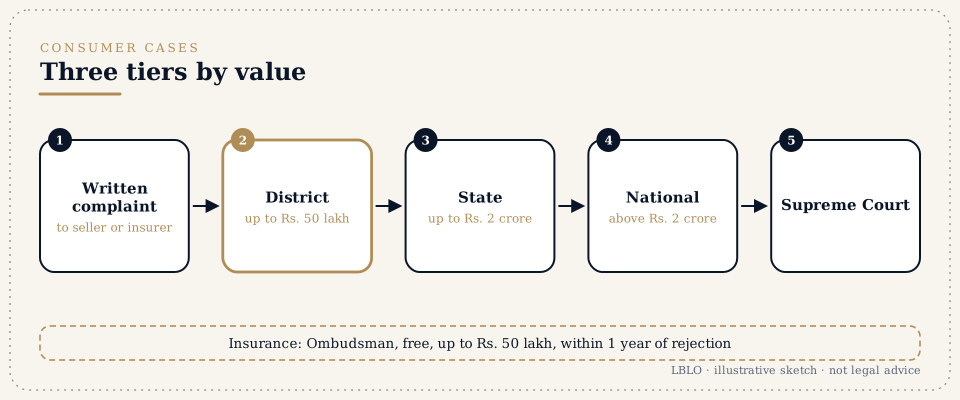
- Where to file depends on the value of the goods or services paid for:
- District Commission: up to Rs. 50 lakh;
- State Commission: above Rs. 50 lakh and up to Rs. 2 crore;
- National Commission: above Rs. 2 crore.
- Time limit. File within two years of the cause of action (Section 69). Delay can be condoned.
- E-filing. Complaints can be filed online on the e-Jagriti portal of the Department of Consumer Affairs, which replaced e-Daakhil from 01/01/2025. A complaint can also be filed where you live or work, not only where the seller or provider is.
- Rejected insurance claims. The Insurance Ombudsman is a free alternative; it can award compensation of up to Rs. 50 lakh. First complain to the insurer in writing, then approach the Ombudsman within one year of the insurer's rejection, or within one year after one month has passed without a reply. The award binds the insurer.
- Medical negligence. The question is whether the doctor or hospital fell below the standard of a reasonably competent practitioner. Medical records and an independent expert opinion usually decide the case.
Terms you will hear
- Consumer
- a person who buys goods or hires services for consideration, other than for resale or a commercial purpose. Self-employment use is generally covered.
- Deficiency in service
- a fault, imperfection or shortcoming in the quality or manner of service.
- Unfair trade practice
- misleading advertisements, false representations, hidden charges.
- Product liability
- claims against the manufacturer, seller or service provider for harm caused by a defective product.
- Repudiation
- the insurer's rejection of a claim, wholly or partly.
- Pre-existing disease and moratorium period
- common grounds for health claim disputes.
- Grievance Redressal Officer and Bima Bharosa
- the insurer's grievance officer, and IRDAI's online grievance portal.
- Medical records and the discharge summary
- the patient is entitled to copies, and they are the core evidence.
- Expert opinion
- an independent doctor's view on whether the treatment met the accepted standard.
In detail
1. Before filing.
- Complain in writing to the seller or provider and keep the reply.
- Collect the invoices, the warranty card, correspondence, photographs and the policy document.
- In insurance cases, get the written rejection letter.
2. The complaint.
It contains:
- the facts in date order;
- the deficiency;
- the loss;
- the relief: a refund, replacement, compensation or costs.
An affidavit and the documents are attached. Mediation is available at the Commission.
3. Insurance claims.
The route is:
- The insurer's grievance cell.
- Bima Bharosa, if needed.
- Either the Ombudsman (free, awards up to Rs. 50 lakh, binding on the insurer only) or the Consumer Commission (no cap, binding on both sides, appealable).
The choice depends on the amount and on whether you may need an appeal.
4. Medical negligence.
Obtain the complete records promptly. Write to the hospital for them. Consider a second opinion. Claims can be made against the hospital and the doctor. Each case is fact-specific, and the bar for proving negligence is meaningful.
5. Education disputes.
Refund of fees after withdrawal, misleading claims about recognition or placement, and denial of certificates are common. Whether a particular dispute is a "service" under the Act depends on its nature. Some matters involving regulatory recognition or examinations go to writ courts instead.
6. Appeals.
- District Commission → State Commission.
- State Commission → National Commission.
- National Commission → Supreme Court.
Each appeal has its own time limit and pre-deposit. An appeal lies to the State Commission within 45 days (Section 41); to the National Commission within 30 days of an order the State Commission made on a complaint (Section 51); and to the Supreme Court within 30 days of an order the National Commission made on a complaint (Section 67). In each case an appellant who has to pay must first deposit 50% of the amount ordered. Delay can be condoned for sufficient cause.
Questions people ask
Do I need a lawyer in the Consumer Commission?
No, but drafting and evidence matter, especially in builder, insurance and medical cases.
The claim is Rs. 80 lakh. Can I go to the Ombudsman?
The Ombudsman cannot award more than Rs. 50 lakh, so the Consumer Commission is the forum for a claim of that size.
The airline cancelled my flight. Is that a consumer case?
Yes, where the refund or compensation required by the rules was not given.
Can I complain against an online seller abroad?
If the platform operates in India, it can be made a party. The e-commerce rules place duties on platforms.
The coaching centre refuses to refund fees. Is that deficiency?
It may be, depending on the contract and what was promised.
These answers are educational summaries; they are not legal advice on any individual matter.
A serious question deserves a read brief.
Conferences are by appointment at G-46, Basement, Greater Kailash III, New Delhi. The principal reads the correspondence.
This page gives general information about the work of Lokesh Bhardwaj Law Offices, as permitted under the Bar Council of India Rules. It is not legal advice, and it does not create an advocate-client relationship. LBLO acts in a matter only on an engagement agreed in writing.
Last reviewed: 15/11/2026. Lokesh Bhardwaj Law Offices.
Law stated as at 15/11/2026.