
RERA and Builder-Buyer Disputes: Refund, Interest, Possession
The Real Estate (Regulation and Development) Act, 2016 (RERA) gives a homebuyer three core remedies where the builder fails to give possession as agreed.
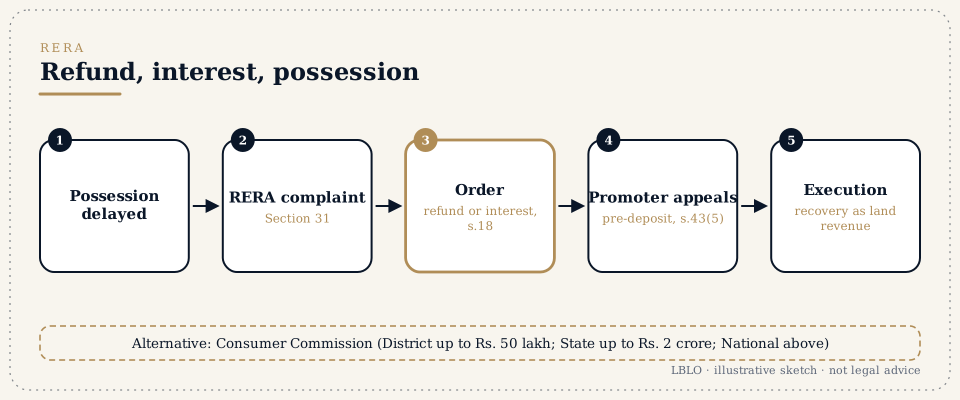
In brief
- The Real Estate (Regulation and Development) Act, 2016 (RERA) gives a homebuyer three core remedies where the builder fails to give possession as agreed:
- a refund with interest;
- interest for every month of delay while the buyer stays in the project;
- compensation.
- Where to file. The complaint goes to the RERA Authority of the State where the project is: Delhi, Haryana (Gurugram or Panchkula), or Uttar Pradesh (for Noida, Greater Noida and Ghaziabad), for example (Section 31).
- Refunds. Section 18 allows a buyer who wishes to withdraw to get back the amount paid with interest at the prescribed rate.
- Challenging an order. A promoter who appeals a RERA order must first deposit at least 30% of the penalty (or a higher percentage the Appellate Tribunal fixes), or the total amount payable to the allottee with interest and compensation, or both, before the appeal is heard (proviso to Section 43(5)). This makes delaying appeals costly for builders.
- Consumer forum. Many buyers can also approach a consumer commission. Which forum suits a case depends on the relief, the amount, and how quickly the buyer needs an enforceable order.
- Insolvency. Where the builder is in insolvency, homebuyers are financial creditors. Their claims are filed with the resolution professional, and the RERA order then becomes part of the claim.
- Documents. The essentials are the allotment letter, the builder-buyer agreement, the payment receipts, the demand letters and the project's RERA registration page.
Terms you will hear
- Promoter, allottee
- the builder, and the buyer.
- RERA registration number
- every ongoing project above the threshold must be registered. The registration page shows the declared completion date.
- Agreement for sale (builder-buyer agreement, BBA)
- the contract fixing price, specifications and the possession date.
- Possession date and grace period
- the promised date, and any extra period the agreement allows.
- Occupancy certificate (OC) and completion certificate (CC)
- the municipal certificates that the building is complete and fit to occupy. An offer of possession without an OC is a common dispute.
- Carpet area and super area
- carpet area is the net usable floor area of the apartment, excluding the external walls, service shafts and exclusive balconies or terraces, but including internal partition walls (Section 2(k)). The promoter must disclose the carpet area of the apartments for sale (Section 4(2)(h)).
- Delayed-possession interest (DPI)
- monthly interest for the period of delay.
- Separate project account (the 70% account)
- the account in a scheduled bank into which the promoter must deposit 70% of the amounts realised from allottees, to be used only for the land and construction cost of that project (Section 4(2)(l)(D)).
- Execution petition
- the proceeding to enforce a RERA order. Recovery can be as arrears of land revenue.
- Subvention scheme
- a scheme where the builder pays the EMIs on the buyer's home loan until possession. Disputes arise when the builder stops paying.
In detail
1. Choose the remedy.
- Withdraw: the buyer takes a refund with interest.
- Stay: the buyer keeps the unit and claims delay interest, possession with the OC, and correction of deficiencies.
The choice depends on how far the project has progressed, the builder's solvency, and the buyer's need for the home.
2. The complaint.
Filed online on the State RERA portal in the prescribed form, with the documents listed above. Hearings are frequent and short. Orders typically set a period for compliance.
3. Appeal.
An appeal from the Authority lies to the State Real Estate Appellate Tribunal within 60 days from the date on which a copy of the order is received; the Tribunal may admit a later appeal on sufficient cause (Section 44(2)). A further appeal lies to the High Court within 60 days of communication of the Tribunal's order, on the grounds in Section 100 CPC (Section 58).
The pre-deposit under Section 43(5) applies to promoters.
4. Enforcement.
If the builder does not pay, the buyer files for execution. Recovery certificates can be issued and enforced like land revenue. This is slow in some States, and persistent follow-up matters.
5. Consumer commissions as an alternative.
Pecuniary jurisdiction under the 2021 Rules:
- District Commission: up to Rs. 50 lakh;
- State Commission: above Rs. 50 lakh and up to Rs. 2 crore;
- National Commission: above Rs. 2 crore.
The limitation period is two years from the cause of action (Section 69), and delay can be condoned.
6. When the builder is insolvent.
Homebuyers file their claims electronically, in the form the IBBI notifies by circular, with the interim resolution professional. They vote as a class through an authorised representative. Individual RERA execution generally pauses under the moratorium.
7. Buyer's checklist before booking.
Check:
- the RERA registration and its declared completion date;
- litigation against the promoter;
- title and land-use;
- sanctioned plans;
- the escrow bank;
- the agreement's possession and penalty clauses.
The Office's title verification page covers the land side.
Questions people ask
The builder offered possession without an OC. Must I accept?
An offer of possession without an occupancy certificate is generally not a valid offer. Raise it in writing and seek interest until a valid offer is made.
Can I get a refund after the possession date has passed?
Yes, a buyer can seek a refund with interest under Section 18 where possession is not given as agreed.
RERA or consumer court?
It depends on the amount, the relief and the speed of enforcement in your State. Both should be assessed before filing.
What interest rate applies?
The rate prescribed by the State rules, usually linked to the SBI marginal cost of lending rate plus a margin. Confirm the State rule for your project.
The builder is now under insolvency. Is my RERA order useless?
No. It supports your claim before the resolution professional. Recovery depends on the resolution plan.
These answers are educational summaries; they are not legal advice on any individual matter.
A serious question deserves a read brief.
Conferences are by appointment at G-46, Basement, Greater Kailash III, New Delhi. The principal reads the correspondence.
This page gives general information about the work of Lokesh Bhardwaj Law Offices, as permitted under the Bar Council of India Rules. It is not legal advice, and it does not create an advocate-client relationship. LBLO acts in a matter only on an engagement agreed in writing.
Law stated as at 15/11/2026.