
Leases, Tenancy and Eviction: Landlords and Tenants in Delhi
In Delhi, which law governs a tenancy depends on the rent and the area.
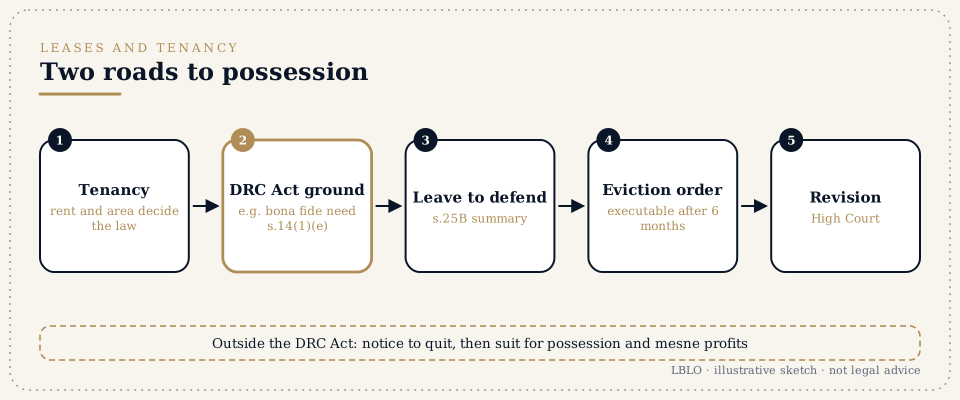
In brief
- Which law applies? In Delhi, the answer depends on the rent and the area:
- Premises covered by the Delhi Rent Control Act, 1958 (DRC Act) can be recovered only on the grounds the Act lists, before the Rent Controller.
- Premises outside it, typically where the monthly rent is above Rs. 3,500 (Section 3(c)), are recovered by a civil suit for possession after the lease ends or a notice terminates it.
- Bona fide need. The most used DRC ground is the landlord's bona fide requirement for themselves or a dependent family member (Section 14(1)(e)). It follows a fast summary procedure (Section 25B), which also applies to the special grounds in Sections 14A to 14D. The tenant must get the Controller's leave to defend. Without it, eviction follows.
- Commercial leases are mostly contract cases: rent, escalation, lock-in, security deposit, maintenance, renewal and exit. A well-drafted lease avoids most disputes.
- Leave and licence. Many owners use a leave and licence agreement instead of a lease. The label alone does not decide the relationship; the substance does.
- Registration. A lease from year to year, for a term exceeding one year, or reserving a yearly rent must be registered (Section 17(1)(d), Registration Act, 1908), and every lease must be stamped. An unregistered lease that needed registration may be inadmissible for some purposes.
Terms you will hear
- Lessor, lessee; landlord, tenant; licensor, licensee
- the parties under a lease or a licence.
- Lock-in period
- the period during which neither side can end the lease (or only one side can).
- Escalation
- the periodic increase in rent.
- Security deposit
- the refundable amount held against damage or arrears.
- Notice to quit
- the notice ending the tenancy, required before a possession suit outside rent control.
- Leave to defend
- permission the tenant needs to contest a bona fide need eviction under Section 25B.
- Standard rent
- under the DRC Act, the rent the Controller can fix.
- Mesne profits and damages for use and occupation
- compensation for continued occupation after the tenancy ends.
- Sub-letting
- letting the premises to another without consent. It is a recognised eviction ground.
In detail
1. DRC Act eviction.
Section 14 lists the grounds. Among them:
- non-payment of rent after notice;
- sub-letting;
- misuse;
- bona fide need;
- substantial damage.
For bona fide need, the landlord must show that the need is genuine and that no other reasonably suitable accommodation is available. Courts examine the claimed need on the facts.
Under Section 25B, the tenant files an application for leave to defend, with an affidavit stating the grounds, within 15 days of service of the summons in the form in the Third Schedule (Section 25B(4)). If leave is refused, an eviction order follows. A revision lies to the High Court under the proviso to Section 25B(8). An eviction order for bona fide need is generally not executable for six months from the order (Section 14(7)).
2. Possession suits outside the DRC Act.
The landlord:
- ends the tenancy by notice (or the lease expires);
- files a suit for possession and mesne profits;
- may seek an order for deposit of use and occupation charges during the suit.
Where the tenant admits the tenancy and the rent, judgment on admission under Order XII Rule 6 CPC can bring an early decree.
3. Commercial lease drafting.
Points that decide later disputes:
- lock-in and early exit;
- escalation;
- fit-out period and rent-free period;
- maintenance and common area charges;
- the use clause;
- subletting and group-company assignment;
- refund of the deposit with interest on delay;
- dispute resolution, by arbitration with the seat stated.
4. For tenants.
Keep rent receipts and bank transfer records. Answer notices in writing. Where the landlord refuses rent, a DRC tenant can deposit rent with the Controller (Section 27).
Questions people ask
Does the DRC Act apply to my shop?
It depends on the rent, the date and the area. Check the rent and whether the area is notified.
The tenant has not paid for six months. Can I lock the premises?
No. Self-help eviction is unlawful. Use the legal route.
How long does a bona fide need case take?
The summary procedure is meant to be quick. Contested leave applications and revisions add time.
Is an 11-month agreement safer?
It avoids compulsory registration. It does not make the occupant a trespasser, and does not remove rent control where the Act applies.
The landlord will not return my deposit. What now?
A legal notice, then a recovery suit, or a set-off against the last month's rent where the agreement allows.
These answers are educational summaries; they are not legal advice on any individual matter.
A serious question deserves a read brief.
Conferences are by appointment at G-46, Basement, Greater Kailash III, New Delhi. The principal reads the correspondence.
This page gives general information about the work of Lokesh Bhardwaj Law Offices, as permitted under the Bar Council of India Rules. It is not legal advice, and it does not create an advocate-client relationship. LBLO acts in a matter only on an engagement agreed in writing.
Law stated as at 15/11/2026.