
Civil Suits: Recovery, Possession, Injunction, Partition and Declaration
A civil suit asks a court for money, for property, for an order to do or not do something, for a division of jointly held property, or for a statement of rights.
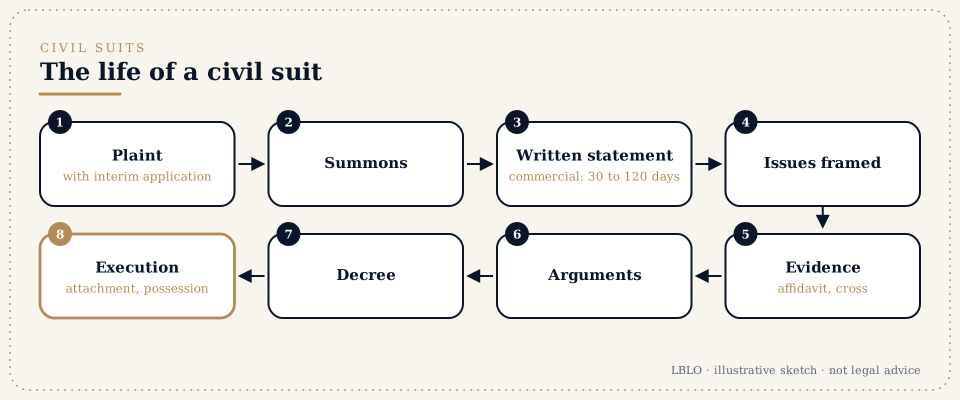
In brief
- A civil suit asks a court for one or more of these remedies:
- money (recovery);
- property (possession);
- an order to do or not do something (injunction);
- a division of jointly held property (partition);
- a statement of rights (declaration).
- Forum. The forum depends on the value of the suit, where the property or the defendant is, and whether the dispute is "commercial".
- Commercial disputes of a specified value of Rs. 3 lakh and above go to the Commercial Courts, which follow stricter timelines.
- In Delhi, suits of a value above Rs. 2 crore go to the Delhi High Court on its original side.
- Limitation. Each kind of suit has its own period under the Limitation Act. A suit for recovery of money is generally three years (for example, Articles 14, 19 and 113 of the Limitation Act, 1963). A suit for possession of immovable property based on title is generally 12 years (Article 65).
- Speed. Where there is no real defence to a money claim based on a written contract, invoice or cheque, a summary suit under Order XXXVII can be much faster.
- Interim relief. An interim injunction (Order XXXIX) or the attachment of property before judgment (Order XXXVIII) can protect the claim while the suit runs.
- Execution. Winning is half the job. Execution of the decree is a separate stage, and the Office plans it from day one.
Terms you will hear
- Plaint, plaintiff, defendant
- the document that starts the suit, the person suing, and the person sued.
- Written statement
- the defendant's reply. In commercial suits, it must be filed within 30 days, extendable to a hard outer limit of 120 days.
- Replication
- the plaintiff's response to the written statement.
- Issues
- the questions the court frames for decision.
- Affidavit of evidence and cross-examination
- how witnesses give evidence and are tested.
- Decree and judgment
- the formal order deciding rights, and the reasons for it.
- Preliminary decree and final decree
- in partition, the first declares the shares and the second divides the property by metes and bounds.
- Mesne profits
- compensation for wrongful occupation of property.
- Lis pendens
- the rule that property transferred during a suit stays subject to the result.
- Ex parte
- a decision in the absence of a party who did not appear after service.
- Court fee
- payable on most plaints, often calculated on the value of the relief (ad valorem).
- Execution, attachment, warrant of possession
- the steps that enforce a decree.
In detail
1. Choosing the suit.
- Recovery. For unpaid invoices, loans or refunds. Where the claim rests on a written contract, bill of exchange, cheque or guarantee, a summary suit under Order XXXVII is available. There, the defendant must obtain the court's leave to defend. Leave can be refused only where the court is satisfied that the defendant has no substantial defence or that the defence is frivolous or vexatious.
- Possession. Against a trespasser, a licensee whose licence has ended, or a tenant outside rent control protection.
- Injunction. To stop an act: construction, transfer of property, use of a mark, a breach of contract. A permanent injunction is the final relief. The interim injunction protects the position until then, and is granted where there is a prima facie case, balance of convenience and irreparable harm.
- Partition. Between co-owners or members of a joint family. The court first declares each share, then divides the property or orders a sale where it cannot be divided.
- Declaration. For example, that a sale deed is void, or that the plaintiff is the owner. A declaration is usually combined with consequential relief, such as possession or an injunction, because a bare declaration may not be granted where further relief was available.
2. Commercial suits.
Commercial suits have:
- compulsory pre-institution mediation, unless urgent interim relief is sought;
- a statement of truth;
- strict timelines for the written statement;
- case management hearings.
They are faster, but procedural mistakes cost more.
3. Evidence.
Civil cases are decided on documents and witnesses. Before filing, the Office assembles:
- the documents;
- the chronology;
- a list of witnesses;
- a note on what the other side is likely to say.
Electronic evidence (emails, messages, CCTV) needs a certificate under Section 63 of the Bharatiya Sakshya Adhiniyam, 2023, which replaced Section 65B of the Evidence Act from 01/07/2024.
4. Execution.
Ways to enforce a money decree include:
- attachment of bank accounts, salary or property;
- sale of property;
- in limited cases, detention of the judgment debtor.
A possession decree is executed by a warrant of possession.
5. Appeals.
A first appeal lies on facts and law. A second appeal lies to the High Court only on a substantial question of law.
Questions people ask
The buyer has not paid three invoices from 2023. Is it too late?
Generally, the three-year period runs from when each payment fell due. A signed written acknowledgement of the debt, or a part-payment acknowledged in writing, made before the period runs out starts a fresh period (Sections 18 and 19 of the Limitation Act, 1963). Check each invoice.
Should I file a summary suit or a regular suit?
A summary suit where the claim rests on a written document and the defence is likely to be weak. A regular suit where the facts are disputed.
My brother is selling our father's house without my consent. What can I do?
A partition suit with an application for an interim injunction against transfer. A notice to prospective buyers can also be published.
How long does a civil suit take?
Years in many courts. Commercial courts are faster. Interim orders often decide the practical outcome early.
Can I get my legal costs back?
Courts can award costs, and commercial courts are expected to follow a "costs follow the event" approach. Full recovery is not assured.
These answers are educational summaries; they are not legal advice on any individual matter.
A serious question deserves a read brief.
Conferences are by appointment at G-46, Basement, Greater Kailash III, New Delhi. The principal reads the correspondence.
This page gives general information about the work of Lokesh Bhardwaj Law Offices, as permitted under the Bar Council of India Rules. It is not legal advice, and it does not create an advocate-client relationship. LBLO acts in a matter only on an engagement agreed in writing.
Last reviewed: 15/11/2026. Lokesh Bhardwaj Law Offices.
Law stated as at 15/11/2026.