
Starting Corporate Insolvency: Sections 7, 9 and 10 and the Moratorium
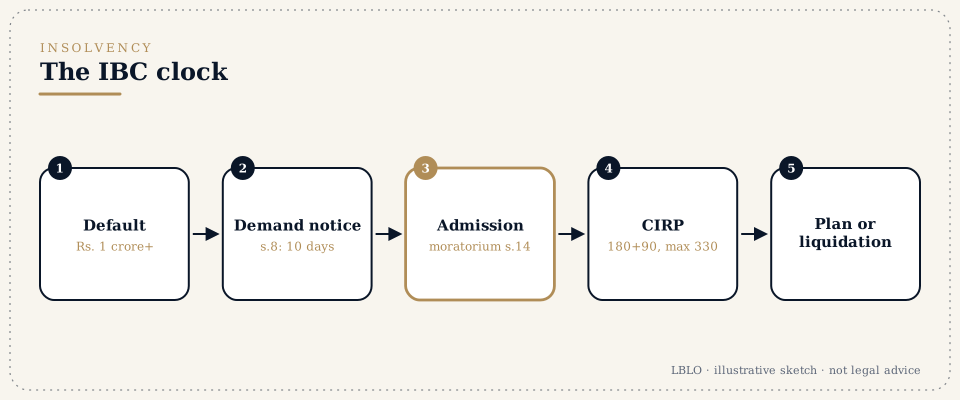
A corporate insolvency resolution process under the Insolvency and Bankruptcy Code, 2016 (IBC) can be started by a financial creditor, by an operational creditor after a demand notice, or by the company itself. It begins only when the National Company Law Tribunal admits the application, and admission brings the moratorium.
In brief
- Threshold and forum. Part II of the IBC applies where the default is at least Rs. 1 crore. The application goes to the National Company Law Tribunal (NCLT) bench with jurisdiction over the company's registered office.
- Three doors. A financial creditor applies under Section 7 on default. An operational creditor first serves a demand notice under Section 8 and applies under Section 9 only if the company neither pays nor points to a dispute within 10 days. The company itself applies under Section 10.
- 2026 changes. Most of the IBC (Amendment) Act, 2026 came into force on 26/05/2026. The Tribunal now shall admit a complete Section 7 application within 14 days once a default is shown, and no other ground can defeat it.
- Moratorium. Admission triggers a moratorium under Section 14 on suits, execution, enforcement of security and recovery of property against the company. It does not, by its terms, protect a guarantor.
- Time limit. Section 7 and Section 9 applications must be filed within three years of the date of default, subject to an acknowledgment of liability by the company.
- Court fee. Rs. 25,000 for a financial creditor or the company, and Rs. 2,000 for an operational creditor, under the Schedule to the 2016 Application Rules.
Terms you will hear
- Financial creditor
- a person owed a financial debt, that is, money disbursed against the consideration for the time value of money. A homebuyer's payments to a developer count as a financial debt under Section 5(8)(f).
- Operational creditor
- a person owed an operational debt: a claim for goods or services, including employment, or statutory dues payable to the government or a local authority (Section 5(21)).
- Corporate applicant
- the company itself, or a member, partner, manager or person in control of its finances who is authorised to apply for it (Section 5(5)).
- Default
- non-payment of a debt, in whole or in part, once it has become due and payable. Part II applies only where the default is at least Rs. 1 crore.
- Demand notice
- the notice in Form 3, or an invoice with the notice in Form 4, that an operational creditor must deliver before applying under Section 9.
- Pre-existing dispute
- a real dispute about the debt, the goods or services, or a warranty that existed before the demand notice was received. It defeats a Section 9 application.
- Interim resolution professional (IRP)
- the insolvency professional appointed on admission, who takes over the management of the company until the committee of creditors appoints a resolution professional.
- Moratorium
- the statutory freeze under Section 14 on suits, execution, enforcement of security and recovery of property against the company during the process.
In detail
Before filing: the threshold, the forum and the 2026 amendments
The corporate insolvency provisions in Part II of the IBC apply where the minimum amount of default is Rs. 1 crore (Section 4, read with the notification of 24/03/2020 that raised the figure from Rs. 1 lakh). The forum is the NCLT, acting as the Adjudicating Authority. The bench is the one with territorial jurisdiction over the place where the company's registered office is located (Section 60(1)).
The Code was substantially amended by the Insolvency and Bankruptcy Code (Amendment) Act, 2026 (Act 6 of 2026), which received assent on 06/04/2026. Notification S.O. 2625(E) dated 22/05/2026 brought most of its provisions into force on 26/05/2026. That includes the changes to Sections 7, 9, 10, 12A, 14 and 16 described on this page.
The creditor-initiated insolvency resolution process (new Chapter IV-A), group insolvency (Chapter VA) and the cross-border rule-making power (Section 240C) were left out, and no later notification bringing them into force had been found as at the date of this page.
Three questions come before the merits. Is insolvency the right tool? The IBC is a collective process, not a recovery suit. Is the application in time? Under Article 137 of the Limitation Act, 1963, applied by Section 238A, it must be filed within three years of the default, and a written acknowledgment of liability by the company restarts the period (see the limitation page for the IBC). Is it bona fide? Since 26/05/2026 the Tribunal may impose a penalty of Rs. 1 lakh to Rs. 2 crore for a frivolous or vexatious proceeding (Section 64A).
Section 7 applications by financial creditors
Who may apply
A financial creditor may apply alone, or jointly with other financial creditors, once a default has occurred. A default in a debt owed to any financial creditor of the company is enough, not only a default owed to the applicant (Explanation to Section 7(1)).
An amount raised from an allottee under a real estate project is deemed to have the commercial effect of a borrowing (Explanation to Section 5(8)(f)). Homebuyers are therefore financial creditors. But allottees, and creditors in a class such as deposit holders, must apply jointly: at least 100 creditors of the same project or class, or 10% of them, whichever is less (provisos to Section 7(1)).
What is filed
- The application in Form 1, under Rule 4 of the Insolvency and Bankruptcy (Application to Adjudicating Authority) Rules, 2016, with the fee of Rs. 25,000.
- The record of default from an information utility, or other evidence of default. Regulation 2A of the IBBI's resolution process regulations allows certified copies of entries in a bankers' book, or an order of a court or tribunal that has decided the non-payment where the time for appeal has expired.
- A chronology of the debt and default, including part payments, the last acknowledgment and the limitation that applies (Regulation 2D), and the creditor's PAN and email address (Regulation 2C).
- The name of the insolvency professional proposed as IRP, with that person's written consent in Form 2 (Rule 9).
- Proof that a copy was served on the company and the IBBI before filing (Rule 4(3)).
What the Tribunal decides, and in what time
Since 26/05/2026, Section 7(5) says the Tribunal shall, within 14 days of receiving the application, admit it if three things are shown: a default has occurred, the application is complete, and no disciplinary proceeding is pending against the proposed resolution professional. It rejects the application if any of these fails. Before rejecting for a defect, it must give the applicant seven days to cure it. If it does not decide within 14 days, it must record its reasons for the delay.
Two explanations were added. Once the three requirements are met, no other ground may be considered to reject the application (Explanation I). Where a financial institution files a record of default from an information utility, that record is enough for the Tribunal to find a default (Explanation II).
The Tribunal does not try the debt. The defences that remain are the statutory ones: no financial debt, no default, a default below Rs. 1 crore, a time bar, or an incomplete application. A dispute only about the amount does not answer an application where a default of at least the threshold is shown.
When the process starts
The process starts on the date of admission, the insolvency commencement date (Section 7(6)). The admission order declares the moratorium, directs a public announcement and appoints the IRP (Section 13). Where a financial creditor applies, the professional it proposed is appointed as IRP, if no disciplinary proceedings are pending against them (Section 16(2)).
The IRP must publish the announcement within three days of appointment. The announcement fixes the last date for claims, which is 14 days from the IRP's appointment (Regulation 6).
Where several applications against the company are pending, the "initiation date" is the date of the first (new proviso to Section 5(11)); look-back periods for avoidance transactions are now counted back from that date and extend up to admission.
An applicant may withdraw before admission with the Tribunal's permission (Rule 8).
Demand notices and Section 9 applications
The demand notice
An operational creditor is a supplier of goods or services, an employee, or a government authority owed statutory dues. It cannot file straight away. On default it must deliver a demand notice in Form 3, or a copy of the unpaid invoice with a notice in Form 4 (Section 8(1); Rule 5(1)).
The notice is delivered at the registered office by hand, registered post or speed post with acknowledgment due, or by email to a whole-time director, designated partner or key managerial person (Rule 5(2)). A copy is also filed with an information utility, if there is one (Rule 5(3)).
Within ten days of receipt, the company must do one of two things (Section 8(2)). It may point to a dispute, or to a suit or arbitration filed before it received the notice. Or it may prove payment, by an attested copy of the record of electronic transfer or of the encashment of its cheque.
The pre-existing dispute
"Dispute" includes a suit or arbitration about the existence of the amount of debt, the quality of goods or services, or the breach of a representation or warranty (Section 5(6)).
In Mobilox Innovations Private Limited v. Kirusa Software Private Limited, (2018) 1 SCC 353, the Supreme Court held that the Tribunal sees only whether there is a plausible contention requiring further investigation. The dispute must not be a patently feeble legal argument or an assertion of fact unsupported by evidence. The Tribunal separates the grain from the chaff, but it need not be satisfied that the defence is likely to succeed.
The dispute must have existed before the notice arrived; correspondence from before that date carries far more weight than objections first raised in the reply.
The application
If, after ten days from delivery, the creditor has neither been paid nor received notice of a dispute, it may apply under Section 9(1). The application is made in Form 5 (Rule 6), with the fee of Rs. 2,000, and is filed with:
- a copy of the demand notice or invoice, and an affidavit that no notice of dispute was received (Section 9(3));
- a certificate in Form 5A from the creditor's bank of the amounts credited by the company, and any information utility record of non-payment, where available;
- since 02/06/2026, under the substituted Regulation 2B: GST return extracts and e-way bills where GST applies, part payments, any assignment or guarantee, a statement of account, whether the creditor is a related party, and other pending recovery proceedings;
- the chronology of debt and default under Regulation 2D, and proof that copies were served on the company and the IBBI (Rule 6(2)).
Since 26/05/2026, Section 215(3) requires an operational creditor to submit its financial information to an information utility before filing a Section 9 application. The company must then authenticate that information within the time the IBBI specifies, failing which it is deemed authenticated (Section 215(4)).
Admission or rejection
Within 14 days, the Tribunal admits the application if five conditions are met: the application is complete, the debt is unpaid, the notice was delivered, no notice of dispute was received and no dispute is recorded with an information utility, and no disciplinary proceeding is pending against a proposed IRP. Otherwise it rejects the application, after giving seven days to cure an incomplete one. If it takes longer than 14 days, it records its reasons (Section 9(5)).
An operational creditor that conceals a dispute the company had raised, or a full and final payment, faces a penalty of Rs. 1 lakh to Rs. 2 crore (Section 67C).
Section 10 applications by the company
A company in default may apply for its own insolvency through a corporate applicant (Section 10(1)). That may be the company itself, an authorised member or partner, the individual managing its operations, or the person in control of its finances (Section 5(5)).
With the application it files information about its books of account and the other information specified. It also files a special resolution of its shareholders, or a resolution of at least three-fourths of its partners, approving the filing (Section 10(3)).
Since 02/06/2026, Regulation 2E lists the information in detail: bank accounts, assets and receivables for three years, creditors, litigation, employees' dues, guarantees, related party transactions, licences, tax demands, attachments by enforcement agencies and, for a developer, its allottees.
Form 6 also requires audited accounts for two years and a recent statement of affairs. The fee is Rs. 25,000, and a copy is served on the IBBI before filing (Rule 7).
Two 2026 changes matter. The company no longer proposes its own IRP. The Tribunal refers the matter to the IBBI, which recommends one (new Section 16(3A); Section 10(3)(b) omitted). And the Tribunal must decide within 14 days, admitting a complete application and rejecting an incomplete one after seven days to cure, with reasons if it is late (Section 10(4)).
Section 11 bars some applications. A company cannot apply while it is already in a resolution process or a pre-packaged process. Nor can it apply within twelve months of completing a resolution process, or of a pre-packaged plan being approved. A company or financial creditor that has violated a plan approved in the last twelve months is barred, and so is a company against which a liquidation order has been made. None of these bars stops the company from applying against another company that owes it money (Explanation II).
A company that files loses its board's powers on admission (Section 17), and its directors' past conduct becomes open to scrutiny for fraudulent or wrongful trading (Section 66).
No application may ever be filed for a default that arose in the period suspended under Section 10A, which began on 25/03/2020 and could not exceed one year.
The moratorium and interim relief
What the moratorium stops
On the insolvency commencement date, the Tribunal declares a moratorium under Section 14(1). It prohibits four things:
- starting or continuing suits and proceedings against the company, including execution of any judgment, decree or order of a court, tribunal, arbitral tribunal or other authority;
- the company transferring, encumbering or disposing of its assets;
- any action to enforce a security interest over its property, including under the SARFAESI Act, 2002;
- recovery of property that the company occupies, by its owner or lessor.
A government licence or concession cannot be suspended or terminated on the ground of insolvency if current dues for it are paid (Explanation to Section 14(1)). Essential supplies specified by the IBBI, and supplies the IRP considers critical and pays for, cannot be cut off (Section 14(2) and (2A)).
What it does not stop
The moratorium does not apply to transactions notified by the Central Government in consultation with a financial sector regulator. Nor does it apply to a surety in a contract of guarantee to the company (Section 14(3)), so a lender may still proceed against a promoter who guaranteed the loan (see personal guarantor insolvency).
A 2026 Explanation closes the reverse route: a surety cannot start or continue an action against the company under the guarantee during the moratorium. The moratorium lasts until the Tribunal approves a resolution plan or orders liquidation (Section 14(4)). Liquidation now carries its own moratorium (Section 33(1)(b)(iv)).
On an application by the IBBI or the Central Government, the Tribunal may impose a penalty of Rs. 1 lakh to Rs. 2 crore on an officer who breaches the moratorium, or on anyone who authorises a creditor's breach (Section 67B).
Management, timelines and withdrawal
From the IRP's appointment, the management of the company vests in the IRP and the board's powers stand suspended (Section 17). The process must be completed within 180 days. The Tribunal may extend this once, by up to 90 days, on a resolution of the committee of creditors passed by 66% of the voting share. The outer limit is 330 days, including time spent in litigation (Section 12).
Since 26/05/2026, an admitted application can be withdrawn under the substituted Section 12A only on an application by the resolution professional, approved by 90% of the voting share of the committee of creditors. Withdrawal is not allowed before the committee is constituted, or after the first invitation for resolution plans is issued. The Tribunal must decide within 30 days.
Before admission
The Code gives a company no moratorium between filing and admission. Until then, suits and enforcement continue unless a court or tribunal makes a specific order, which is why settlement talks usually happen before the admission hearing.
Common mistakes
- Filing on a default below Rs. 1 crore, or more than three years old with no acknowledgment of liability.
- Serving a demand notice by a mode Rule 5 does not permit, or filing before ten days from delivery have run.
- For a company, raising its dispute for the first time in the reply to the demand notice.
- Filing without the chronology of default, the GST records or proof of service on the company and the IBBI.
Questions people ask
What is the minimum default to file insolvency against a company in India?
Part II of the Insolvency and Bankruptcy Code, 2016 applies where the default is at least Rs. 1 crore. Section 4 fixes Rs. 1 lakh, but allows the government to notify a higher figure of up to Rs. 1 crore, and by notification of 24/03/2020 it chose Rs. 1 crore. A financial creditor may count a default owed to any financial creditor of the company. A creditor owed less must use another remedy, such as a commercial suit, arbitration or, for a registered micro or small enterprise, the MSME Facilitation Council.
How long does the NCLT take to admit a Section 7 application?
The Code says the Tribunal shall decide within 14 days of receiving the application, and since 26/05/2026 it must record its reasons in writing if it takes longer. Before rejecting an application for a defect, it must give the creditor seven days to cure it. In practice the time depends on the bench's list, service on the company and any objections raised. No official average is published, so the 14 days should be read as the statutory target rather than a promise.
Can a company defeat a Section 7 application by showing it is solvent?
Not since 26/05/2026. Section 7(5) now directs the Tribunal to admit the application where a default has occurred, the application is complete and no disciplinary proceeding is pending against the proposed resolution professional. Explanation I adds that, once these are met, no other ground can be considered. The answers that remain are the statutory ones: there is no financial debt, there is no default, the default is below Rs. 1 crore, the claim is time-barred, or the application is incomplete.
What should a company do when it receives an IBC demand notice?
Reply in writing within ten days of receipt under Section 8(2). If there is a genuine dispute that existed before the notice, about the amount, the quality of goods or services or a warranty, set it out with the earlier correspondence, or refer to a suit or arbitration already filed. If the debt has been paid, send an attested record of the bank transfer or of the cheque being encashed. Silence, or a dispute invented after the notice, usually leads to admission.
What counts as a pre-existing dispute under the IBC?
The Supreme Court in Mobilox Innovations v. Kirusa Software held that the Tribunal only checks whether there is a plausible contention needing further investigation, which is not a patently feeble legal argument or an assertion of fact unsupported by evidence. It does not decide who is right. The dispute must exist before the demand notice is received. Rejection notes, quality complaints, debit notes and emails written at the time are the usual proof, together with any suit or arbitration filed earlier.
Can an operational creditor file Section 9 without sending a demand notice?
No. Section 9(1) allows an application only after ten days from delivery of the demand notice or invoice under Section 8, and the Tribunal rejects an application where the notice was not delivered. The notice must be in Form 3, or an invoice with a notice in Form 4, delivered at the registered office or by email to a director or key managerial person as Rule 5 provides. Since 26/05/2026 the creditor must also submit its financial information to an information utility before filing.
What is the court fee for an insolvency application before the NCLT?
The Schedule to the Insolvency and Bankruptcy (Application to Adjudicating Authority) Rules, 2016 fixes Rs. 25,000 for an application by a financial creditor, whether alone or jointly, Rs. 2,000 for an application by an operational creditor and Rs. 25,000 for an application by the company itself. Other costs arise later, such as the expenses of the public announcement, which the applicant bears and the committee of creditors may reimburse, and the fees of the insolvency professional.
Can a company file for its own insolvency, and who runs it afterwards?
Yes. Under Section 10 a corporate applicant may apply once the company is in default, with a special resolution of its shareholders or a resolution of three-fourths of its partners. Since 26/05/2026 the company no longer proposes its own interim resolution professional; the Tribunal asks the IBBI to recommend one. On admission the board's powers are suspended and the interim resolution professional runs the company, followed by the resolution professional the committee of creditors appoints.
Does the moratorium protect directors and guarantors?
No. The moratorium under Section 14 protects the corporate debtor and its assets. Section 14(3)(b) says it does not apply to a surety in a contract of guarantee to the company, so a bank may still proceed against a director or promoter who gave a personal guarantee, including through insolvency proceedings against that person. Since 26/05/2026, however, a guarantor cannot sue the company under the guarantee while the moratorium lasts. Proceedings against directors in their own capacity are also outside it.
Can an insolvency application be withdrawn after the NCLT admits it?
Only within narrow limits. Under the substituted Section 12A, in force from 26/05/2026, the resolution professional applies for withdrawal with the approval of 90% of the voting share of the committee of creditors. Withdrawal is barred before the committee is constituted and after the first invitation for resolution plans has been issued, and the Tribunal must decide within 30 days. Before admission, the applicant may withdraw with the Tribunal's permission under Rule 8 of the 2016 Rules.
These answers are educational summaries; they are not legal advice on any individual matter.
A serious question deserves a read brief.
Conferences are by appointment at G-46, Basement, Greater Kailash III, New Delhi. The principal reads the correspondence.
This page gives general information about the work of Lokesh Bhardwaj Law Offices, as permitted under the Bar Council of India Rules. It is not legal advice, and it does not create an advocate-client relationship. LBLO acts in a matter only on an engagement agreed in writing.
Law stated as at 16/11/2026.