
Insurance Claims: Repudiation, Delay and the Insurance Ombudsman
When an insurer rejects a claim, pays part of it or simply does not decide it, the policyholder has three routes: a written complaint to the insurer, the Insurance Ombudsman, and the Consumer Commission.
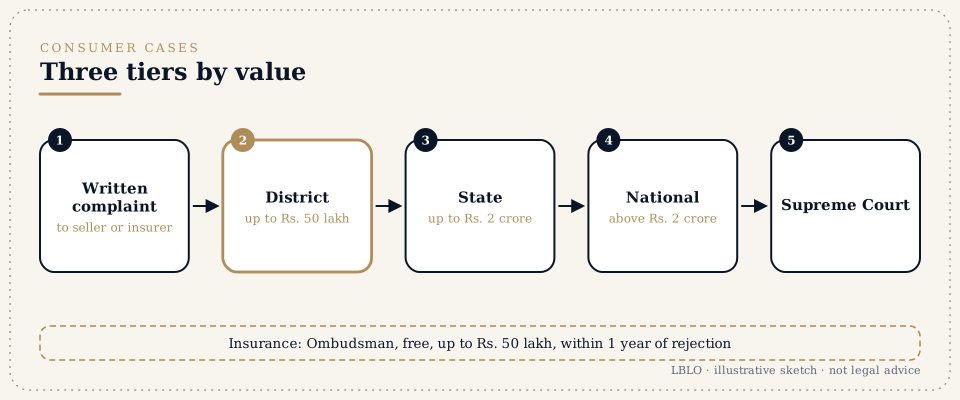
In brief
- Ask for the rejection in writing, with the policy clause relied on. Exclusion clauses are read strictly against the insurer, and the insurer must prove that an exclusion applies.
- Delay in informing the insurer is not, by itself, a ground to reject a genuine theft claim where the FIR was lodged promptly, as a three-judge bench of the Supreme Court held in 2020.
- The Insurance Ombudsman hears complaints about personal lines, group policies and policies of sole proprietorships and micro enterprises, against insurers, their agents and intermediaries, and insurance brokers.
- A complaint to the Ombudsman needs a prior written complaint to the insurer and must be made within one year of its rejection, or of one month passing without reply; the Ombudsman may condone delay.
- The Ombudsman can award compensation of up to Rs. 50 lakh, should decide within three months of receiving all requirements, and its award binds the insurer, which must comply within 30 days.
- A consumer complaint lies within two years of the cause of action before the District, State or National Commission according to the premium or consideration paid; the Ombudsman cannot take up a matter already before a court or commission.
Terms you will hear
- Repudiation
- The insurer's rejection of a claim, in whole or in part.
- Exclusion clause
- A term of the policy that takes a risk outside the cover.
- Utmost good faith
- The duty of both proposer and insurer to disclose material facts honestly when the contract is made.
- Material fact
- A fact that would influence a prudent insurer in deciding whether to accept the risk and on what terms.
- Grievance Redressal Officer
- The insurer's officer who must receive and decide complaints before an outside forum is approached.
- Bima Bharosa
- The grievance portal of the Insurance Regulatory and Development Authority of India (IRDAI).
- Insurance Ombudsman
- The forum under the Insurance Ombudsman Rules, 2017, which mediates and makes awards binding on the insurer.
- Council for Insurance Ombudsmen
- The body that administers the Ombudsman offices and runs the online complaint system.
- Surveyor
- The person appointed to assess loss in a general insurance claim; the report is usually the central document.
In detail
Insurance claim repudiation and delay
An insurance policy is a contract, but a special one. The proposer must disclose material facts; the insurer drafts the policy and decides the claim. The courts hold each side to its part, and they read the insurer's terms closely.
The usual grounds of rejection
- Non-disclosure or misstatement in the proposal form, for example of an earlier illness or of other policies.
- Exclusions and sub-limits in the policy wording.
- Breach of a condition, such as late intimation, failure to co-operate, or use of a vehicle outside the permit.
- Fraud or exaggeration, or a loss said not to fall within the cover at all.
How the courts test these grounds
In Texco Marketing Pvt. Ltd. v. TATA AIG General Insurance Co. Ltd., (2023) 1 SCC 428 the Supreme Court held that an exclusion clause must be read differently from other terms: both the onus and the burden lie on the insurer that relies on it, and an ambiguous clause is read against the insurer that drafted it. In Gurshinder Singh v. Shriram General Insurance Co. Ltd., Civil Appeal No. 653 of 2020, decided on 24/01/2020 a three-judge bench held that where the insured lodged an FIR immediately after a vehicle was stolen, the police filed a final report after failing to trace it, and the insurer's own investigator found the theft genuine, delay in informing the insurer is not a ground to deny the claim; rejecting genuine claims on such technical grounds was called hyper-technical.
For life policies, Section 45 of the Insurance Act, 1938 restricts the period within which an insurer may question a policy for misstatement, and the insurer bears a heavy burden. In Mahakali Sujatha v. Branch Manager, Future Generali India Life Insurance Co. Ltd., Civil Appeal No. 3821 of 2024, decided on 10/04/2024 the Supreme Court held that an insurer alleging suppression of other policies must prove the fact by evidence and show its materiality and the insured's knowledge; a bare allegation in an affidavit is not enough.
Delay in settlement
Delay is itself a ground of complaint. The Insurance Ombudsman Rules list delay in settlement beyond the time fixed in the IRDAI's regulations as the first ground on which a complaint may be made (Rule 13(1)(a)), and an award carries interest at the rate the regulations specify, from the date the claim ought to have been settled (Rule 17(7)).
First steps
- Obtain the rejection or partial settlement letter, with the clause relied on, and the surveyor's or investigator's report.
- Write to the insurer's Grievance Redressal Officer, answering each ground, and keep proof of sending. The complaint can also be registered on Bima Bharosa.
- Collect the policy and proposal form, premium receipts, claim form, medical or repair records, bills, the FIR where relevant, and all correspondence.
- Choose the outside forum: the Ombudsman or the Consumer Commission.
The Insurance Ombudsman
The Insurance Ombudsman Rules, 2017 were made under Section 24 of the IRDA Act, 1999 (G.S.R. 413(E) of 25/04/2017) and amended in 2018, twice in 2021 and on 09/11/2023 (G.S.R. 828(E)). The Ombudsman offices are administered by the Council for Insurance Ombudsmen.
Who and what it covers
- Complaints on personal lines of insurance, group policies, and policies of sole proprietorships and micro enterprises (Rules 2 and 3), against insurers, their agents and intermediaries, and insurance brokers.
- Grounds include delay in settlement, partial or total repudiation, premium disputes, misrepresentation of policy terms, interpretation of the policy as it affects a claim, policy servicing, a policy not matching the proposal, non-issue of a policy after premium was paid, and non-observance of IRDAI's regulations and circulars on these matters (Rule 13(1)).
- The complaint goes to the Ombudsman within whose territory the insurer's branch or the complainant's residence is located (Rule 14(1)).
Conditions
- A prior written representation to the insurer or broker (by letter, email or the insurer's website), and either its rejection, no reply within one month of its receipt, or an unsatisfactory reply (Rule 14(3)(a)).
- The complaint within one year of the rejection or unsatisfactory decision, or of the end of one month after the representation if no reply came (Rule 14(3)(b)). The Ombudsman may condone delay after hearing the insurer and recording reasons (Rule 14(4)).
- No complaint lies on a matter pending before, or decided by, a court, consumer forum or arbitrator (Rule 14(5)).
- The complaint may be made on paper, by email or online through the Council's website, with the facts, documents, loss and relief sought (Rule 14(2)). No fee is prescribed.
Mediation, hearing and award
- If the parties consent in writing to mediation, the Ombudsman makes a recommendation within one month; the complainant accepts within 15 days, and the insurer complies within 15 days of receiving the acceptance (Rule 16).
- Otherwise the Ombudsman hears both sides, may seek expert opinion and may hear the matter by video-conference (Rule 15), and passes a reasoned award within three months of receiving all requirements from the complainant (Rule 17(4)).
- The award cannot exceed the loss directly caused, and cannot exceed Rs. 50 lakh including expenses (Rule 17(3), as amended on 09/11/2023).
- The insurer must comply within 30 days of receiving the award (Rule 17(6)), and the award binds the insurer (Rule 17(8)). The Rules make the award binding on the insurer; they do not in terms bind the complainant.
Consumer complaints against insurers
Insurance is a service under the Consumer Protection Act, 2019, and a wrongful rejection or unreasonable delay is a deficiency in service. The Ombudsman Rules themselves adopt the Act's definition of deficiency (Explanation to Rule 13(1)).
Which Commission and when
- The District Commission hears complaints where the consideration paid does not exceed Rs. 50 lakh, the State Commission above Rs. 50 lakh up to Rs. 2 crore, and the National Commission above Rs. 2 crore, under the Jurisdiction Rules of 2021. In insurance cases the consideration is the premium paid; the claim amount does not decide the forum.
- The complaint may be filed where the insurer carries on business or has a branch, where the cause of action arose, or where the complainant resides or personally works for gain (Section 34(2)).
- It must be filed within two years of the cause of action, ordinarily the date of the rejection; a later complaint needs sufficient cause, which the Commission records (Section 69).
- Complaints are filed online on the e-Jagriti portal of the Department of Consumer Affairs.
Appeals
An appeal lies from the District Commission to the State Commission within 45 days, from an original order of the State Commission to the National Commission within 30 days, and from an original order of the National Commission to the Supreme Court within 30 days, in each case with a deposit of 50 per cent of the amount ordered by an appellant who has to pay (Sections 41, 51 and 67).
Ombudsman or Commission
- Amount. The Ombudsman cannot award more than Rs. 50 lakh; the Commissions have no ceiling.
- Finality. The Ombudsman's award binds the insurer, which has no appeal under the Rules; a Commission's order binds both sides and is appealable by either.
- Speed and cost. The Ombudsman charges no fee and has a three-month timeline; the Commission allows fuller pleadings and evidence, which suits disputed facts.
- One route. Because the Ombudsman cannot hear a matter pending before or decided by a consumer forum, filing before the Commission first closes the Ombudsman route, so the choice should be made at the outset.
Health, motor, life and property claims
Health insurance
Disputes usually concern pre-existing diseases and waiting periods, the sub-limits on particular treatments or room rent, whether a treatment is "experimental", and delay in cashless authorisation. The policy wording and the proposal form should be read with IRDAI's current regulations and circulars on health insurance; non-observance of those regulations and circulars is itself a ground of complaint to the Ombudsman (Rule 13(1)(i)). The treating doctor's written explanation of why the treatment was needed is often the most useful single document. The Office's article on insurers and modern treatment discusses the question of experimental treatment in detail.
Motor insurance
An own-damage claim depends on the surveyor's assessment, the repair bills and the policy conditions on the driver and use of the vehicle. A theft claim depends on a prompt FIR, the police final report and the insurer's investigation; after Gurshinder Singh v. Shriram General Insurance Co. Ltd., Civil Appeal No. 653 of 2020, decided on 24/01/2020 late intimation alone is not a ground of rejection. A claim by a third party injured by the vehicle is not a policy dispute at all: it goes to the Motor Accidents Claims Tribunal, explained on the page on motor accident claims.
Life insurance
Death claims are most often refused for non-disclosure of illness or of other policies. Section 45 of the Insurance Act limits how long after the policy the insurer may raise such a ground, and Mahakali Sujatha v. Branch Manager, Future Generali India Life Insurance Co. Ltd., Civil Appeal No. 3821 of 2024, decided on 10/04/2024 places the burden of proving suppression, materiality and knowledge on the insurer.
Property and fire insurance
These claims turn on the surveyor's report, the books and stock records of the insured, and the exclusions. Texco Marketing Pvt. Ltd. v. TATA AIG General Insurance Co. Ltd., (2023) 1 SCC 428 requires the insurer to prove that an exclusion applies, and an ambiguous exclusion is read in favour of the insured. Policies of sole proprietorships and micro enterprises can go to the Ombudsman; other business policies go to the Consumer Commission, or to arbitration where the policy provides for it on quantum.
Questions people ask
My insurance claim has been rejected. What should I do first?
Ask for the rejection in writing with the exact policy clause relied on, and for the surveyor's or investigator's report. Then write to the insurer's Grievance Redressal Officer, answering each ground with documents, and keep proof of sending; the complaint can also be registered on IRDAI's Bima Bharosa portal. If the insurer rejects the complaint, does not reply within one month, or replies unsatisfactorily, you may go to the Insurance Ombudsman within one year, or file a consumer complaint within two years of the cause of action.
What is the maximum amount the Insurance Ombudsman can award?
Rs. 50 lakh, including relevant expenses, under Rule 17(3) of the Insurance Ombudsman Rules, 2017 as amended on 09/11/2023. The award also cannot exceed the loss suffered as a direct consequence of the cause of action. If the amount at stake is higher, the Consumer Commission is the forum, since it has no ceiling. The cap concerns what the Ombudsman awards, not the size of the policy, so a large policy with a smaller disputed claim can still go to the Ombudsman.
Is the Insurance Ombudsman's award binding?
It is binding on the insurer or insurance broker (Rule 17(8)), which must comply within 30 days of receiving it and report compliance (Rule 17(6)). The Rules do not provide the insurer an appeal. The award carries interest, at the rate in IRDAI's regulations, from the date the claim should have been settled. Where an insurer does not comply, the complainant can report the non-compliance to the Ombudsman and to IRDAI.
How long does the Insurance Ombudsman take to decide a complaint?
The Rules require the Ombudsman to pass an award within three months of receiving all requirements from the complainant (Rule 17(4)). Where the parties agree to mediation, the Ombudsman makes a recommendation within one month of their written consent, the complainant accepts it within 15 days, and the insurer complies within 15 days of receiving the acceptance (Rule 16). The time therefore depends partly on how complete the complaint is when filed; sending every document with it avoids delay.
Can I go to the consumer court and the Insurance Ombudsman at the same time?
No. Rule 14(5) of the Insurance Ombudsman Rules bars a complaint to the Ombudsman on a subject matter on which proceedings are pending before, or have been decided by, a court, consumer forum or arbitrator. Filing before the Consumer Commission first therefore closes the Ombudsman route for the same grievance. The choice should be made at the start, considering the amount, whether the facts are disputed and need evidence, and whether an appeal may be needed.
Can an insurer reject a claim because I informed it late?
Not if the delay caused it no real prejudice and the claim is genuine. In Gurshinder Singh v. Shriram General Insurance (2020), a three-judge bench of the Supreme Court held that where the FIR for a vehicle theft was lodged immediately, the police could not trace the vehicle, and the insurer's investigator found the theft genuine, mere delay in informing the insurer cannot be a ground to deny the claim. Intimation should still be given as soon as possible, in writing, with the reason for any delay.
Can an insurer reject a life insurance claim for non-disclosure years after the policy was issued?
Section 45 of the Insurance Act, 1938 limits the period within which a life insurer may question a policy on the ground of misstatement or suppression, and after it the policy cannot be called in question on that ground. Even within the period, the insurer must prove its case. In Mahakali Sujatha v. Future Generali India Life Insurance (2024) the Supreme Court held that the insurer must prove the suppressed fact by evidence, its materiality and the insured's knowledge of it; an allegation alone is not enough.
Which consumer commission hears an insurance complaint?
It depends on the consideration paid, which in insurance is the premium, not the sum claimed. Under the 2021 Jurisdiction Rules the District Commission hears complaints up to Rs. 50 lakh, the State Commission above Rs. 50 lakh up to Rs. 2 crore, and the National Commission above Rs. 2 crore. The complaint can be filed where the insurer has a branch, where the cause of action arose, or where you live or work, within two years, and is filed online on the e-Jagriti portal.
Can a business take an insurance dispute to the Insurance Ombudsman?
Only some businesses. The Rules apply to personal lines, group insurance, and policies issued to sole proprietorships and micro enterprises as defined in the MSMED Act, 2006 (Rules 2 and 3). A company or partnership that is not a micro enterprise cannot use the Ombudsman for its commercial policies; its routes are the Consumer Commission where the Consumer Protection Act applies to it, a civil suit, or arbitration where the policy provides for it on the amount of loss.
What documents do I need for an insurance complaint?
The policy and schedule, the proposal form, premium receipts, the claim form, the rejection or settlement letter, the surveyor's or investigator's report, your written complaint to the insurer and its reply, and the records specific to the claim: hospital records, discharge summary and bills for health; FIR, final report and repair estimates for motor; death certificate and medical history for life; stock and account records for property. A short list of dates from purchase of the policy to the last letter makes the complaint easy to follow.
These answers are educational summaries; they are not legal advice on any individual matter.
A serious question deserves a read brief.
Conferences are by appointment at G-46, Basement, Greater Kailash III, New Delhi. The principal reads the correspondence.
This page gives general information about the work of Lokesh Bhardwaj Law Offices, as permitted under the Bar Council of India Rules. It is not legal advice, and it does not create an advocate-client relationship. LBLO acts in a matter only on an engagement agreed in writing.
Law stated as at 16/11/2026.