
Bank Recovery and SARFAESI Action: For Lenders and Borrowers
When a loan secured on property goes bad, banks can take possession without going to court first. This page explains the steps, the deadlines and the remedies on both sides.
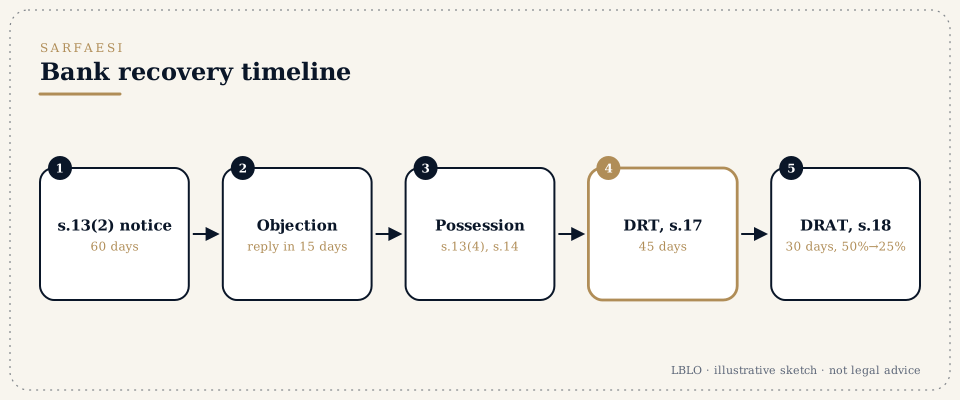
In brief
- What it is. The SARFAESI Act, 2002 lets a secured creditor (a bank or financial institution) enforce its security once a loan account is classified as a non-performing asset. It can take possession of the property and sell it, without a court decree.
- The steps:
- Demand notice (Section 13(2)). The bank issues a notice requiring payment within 60 days.
- Borrower's representation. The borrower may object (Section 13(3A)). If the bank does not accept the objection, it must communicate its reasons within 15 days of receiving it.
- Measures (Section 13(4)). If the borrower does not pay, the bank can take possession, take over management, or sell the asset.
- Possession of the property. The bank can seek the help of the Chief Metropolitan Magistrate or the District Magistrate to take physical possession (Section 14).
- The borrower's remedy.
- An application to the Debts Recovery Tribunal (DRT) under Section 17, within 45 days of a measure.
- An appeal from the DRT to the Debts Recovery Appellate Tribunal (DRAT) within 30 days of receiving the DRT's order (Section 18).
- For the appeal, the borrower must deposit 50% of the debt due, which the DRAT can reduce to not less than 25%.
- For lenders. Recovery can also be pursued through an original application before the DRT (see SARFAESI, the DRT and the DRAT), and through insolvency where the borrower is a company.
- Keep ready:
- the loan and security documents;
- the account statement;
- the NPA classification date;
- the demand notice and the representation and reply;
- the possession notice;
- auction notices.
Terms you will hear
- NPA
- a non-performing asset, a loan in default beyond the regulatory period.
- Section 13(2) notice
- the bank's demand, with 60 days to repay.
- Objection under Section 13(3A)
- the borrower's reply. If the bank rejects it, the bank must give its reasons within 15 days.
- Symbolic and physical possession
- a notice of possession, and actual takeover, sometimes with the Magistrate's assistance under Section 14.
- Reserve price and e-auction
- the minimum price, and the online sale.
- Securitisation application (Section 17)
- the borrower's challenge before the DRT, within 45 days.
- Appeal (Section 18)
- to the DRAT within 30 days, with a deposit of 50% of the debt, reducible to not less than 25%.
- One-time settlement (OTS)
- a negotiated settlement with the bank.
In detail
Step 1: Check the demand notice
The notice must:
- state the amount due;
- identify the secured assets;
- give the full 60 days.
Defects in the notice, or a failure to reply to the borrower's representation, are grounds that the DRT examines.
Step 2: The representation
The borrower should object in writing within the notice period. Points to raise include errors in the amount, a dispute over classification as a non-performing asset, and proposals for settlement. If the bank does not accept the objection, it must give its reasons.
Step 3: Measures and the 45-day window
Once the bank takes a measure, such as a possession notice, the 45-day period for applying to the DRT begins. The DRT can stay further measures, and can set aside measures not taken according to the Act.
Step 4: Auction
The sale notice must give the period the rules require and must state a reserve price. Irregularities in valuation, notice or the conduct of the auction can be challenged.
Step 5: Appeal to DRAT
An appeal lies within 30 days of receipt of the DRT's order. The deposit of 50% of the debt due (reducible to not less than 25%) must be planned for in advance.
Step 6: Settlement
A one-time settlement can be negotiated at any stage. A settlement letter should state the full terms, including release of the security and of any guarantees.
Common mistakes
- For borrowers:
- ignoring the demand notice;
- missing the 45-day window after a possession notice;
- not budgeting for the appeal deposit.
- For lenders:
- notices that give less than 60 days;
- not replying to the representation;
- defects in auction notices.
How LBLO handles these matters
LBLO acts in recovery matters before the DRT and DRAT, and in writ petitions where the action is outside the Act. For borrowers, the 45-day and 30-day periods are worked out from the documents at the outset.
Questions people ask
The bank has put a possession notice on my property. What now?
You have 45 days from the measure to apply to the DRT.
Do I need to deposit money to go to the DRT?
No mandatory deposit applies to the DRT application. A deposit applies to an appeal to the DRAT.
Can a guarantor challenge SARFAESI action?
A guarantor whose property is secured can apply to the DRT against measures taken on that property.
These answers are educational summaries; they are not legal advice on any individual matter.
A serious question deserves a read brief.
Conferences are by appointment at G-46, Basement, Greater Kailash III, New Delhi. The principal reads the correspondence.
This page gives general information about the work of Lokesh Bhardwaj Law Offices, as permitted under the Bar Council of India Rules. It is not legal advice, and it does not create an advocate-client relationship. LBLO acts in a matter only on an engagement agreed in writing.
Law stated as at 14/11/2026.